Monday, 13 November 2017

EFFECTS. Examining the Role of Fish-Falls on Ecosystem processes.

The EFFECTS project is investigating the role of herring carcasses, arriving in Kaldfjorden (close to Tromsø) due to recent shifts in migration patterns of herring in northern Norway on seafloor processes. Input from herring carcasses will be compared with the effects of inputs from aquaculture and jellyfish blooms studied in JellyFarm. 

This research is important to achieve the sustainable management of economic activities in coastal areas that requires a strong understanding of natural and anthropogenic impacts on the ecosystems.  EFFECTS will combine the use of underwater technology, hydrography and biogeochemical modeling and field sampling.


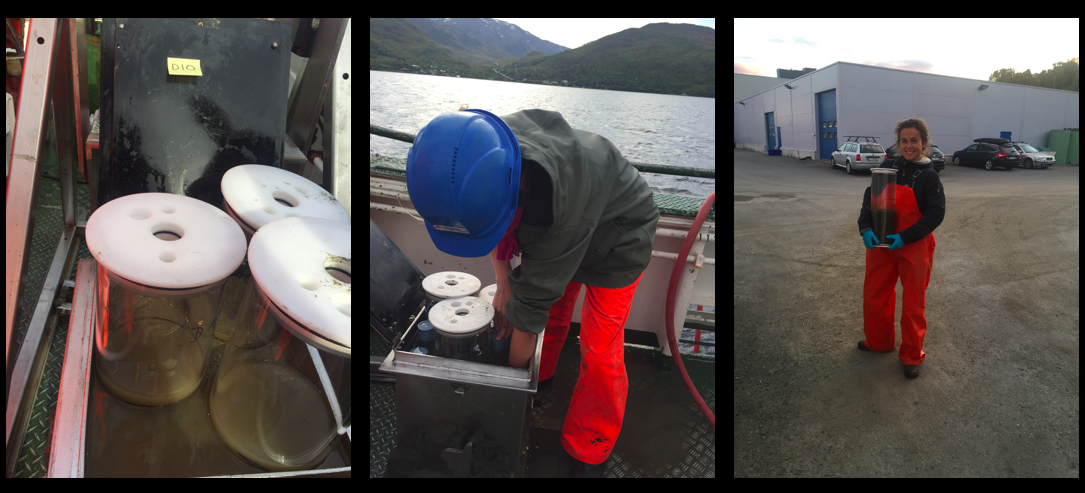
 Underwater camera technology (Anonyx camera lander) and yo-yo drop camera. 


EFFECTS is in collaboration with two other Fram Centre Flagship proposals weShare (Martin Buiw, IMR) and WHALE (Angelika Renner, IMR).  The project involves research collaborartion from Akvaplan-niva, Institute of Marine Research (IMR), Heriot-Watt University (UK), Norsk Institutt for vannforskning (NIVA) and the National Oceanography Center (UK). 


Monday, 23 October 2017

JellyFarm Project presented in PhD presentation at the annual Norske Havforskeres Forening meeting 18-20th of October 2017.

 Introducing the audience to the JellyFarm project.
 Where our samples for the 2017 experiment come from.
 Explaining the experimental set up.
 The treatment the chambers received.
 What we will hopefully gain from the 2016 and 2017 experiment.
I would like to thank Norges Havforskeres Forening on behalf of the JellyFarm project group for the opportunity to present our research.

Friday, 22 September 2017

Jelly Farm Incubation Experiments

Jellyfish (Periphylla periphylla) weighed to be added to benthic cores

Cores transported to microprofiling climate controlled room 

Microprofiling is conducted right before core processing begins

Elisabeth ready for the next core!  

Hege and Elisabeth core slicing

Anouk removes samples for microbiology analysis

The Jelly Farm team enjoying the beautiful views from the Akvaplan niva Barents Sea Lab, Kvaløya. 

Tuesday, 19 September 2017

JellyFarm Field Work Kaldfjorden, Troms


Monday 4th to Thursday 7th of September the JellyFarm team were out in Kaldfjorden to collect box core sediment samples for benthic core incubation experiments. 


 The boat on its way to location.

 Hector and Carl working hard to open the box core.

Experiment chambers were carefully pushed into the sediment in box core and sent over to the lab for further incubation experiments.

Silvia and Anouk slicing sediment cores for further chemical, foraminifera, 13C and nematode analysis.


Despite some difficulties with coarse and rocky seabed several Gemini cores were also collected in Kaldfjorden.


Kaldfjorden Sediment Trap Deployment

Sediment traps were deployed in the Arctic fjord Kaldfjorden, Kvaløya, Tromsø on the 8th September 2017 by Andrew Sweetman (Heriot Watt University), Marta Cecchetto (Heriot Watt University), Hege Vågen (University of Oslo) and Carl Ballantine (Akvaplan Niva).  

Traps will remain in the fjord for 10 months were they will measure the flux of organic material to the seafloor close to a fish farm and in a control site in the center of the fjord.  

Andrew, Carl and Marta heading out to deploy the first sediment trap

Preparing the trap mooring 

Preparing the acoustic releases for the sediment trap mooring deployment

Thursday, 8 June 2017

Looking back at the lab experiment performed at IRIS (Stavanger) in September 2016, looking forward to work with this team on the next experiment in September 2017

WP2: Quantifying interactions between  aquaculture and jelly-falls on organic matter cycling in fjord sediments. 

Sediments collected in Hardanger fjord at two different depths, in the vicinity and at a distance from a fish farm were collected and incubated in the lab at IRIS.

Periphylla periphylla being thawed, weighed and cut before addition to the sediment cores.

Sediment cores incubated in the lab. Andrew Sweetman adding 13C labelled algae before the addition of P. periphylla.

 Andrew Sweetman measuring oxygen profiles in the sediment of experimental cores.


Slicing, measuring, mixing, subsampling and sieving sediments at the end of the experiment.

Team work at its best!