 |
| A big thank you to Elisabeth Alve and her team, at the University of Oslo, for hosting the JellyFarm meeting 2018. |
Wednesday, 31 October 2018
JellyFarm Meeting 2018

Jelly Farm at the Fritt Fram, 2018 Tromsø
 |
| Video footage from the JellyFarm project was used at the Fritt Fram event in the Fram Centre, Tromsø, to communicate information about the use of underwater cameras in marine research. |
Friday, 21 September 2018
JellyFarm at the Deep Sea Biology Symposium 2018, Monterey
Results from the JellyFarm project were presented at the Deep Sea Biology Symposium in Monterey, September 2018, hosted by Monterey Bay Aquarium Research Institute.
 |
| Lightening talk for the poster entitled (Scavenging Processes on Jellyfish Carcasses Across a Fjord Depth Gradient. Dunlop, K.M., Jones, D.O.B. and Sweetman, A.K) |
 |
| Kathy Dunlop at the Monterey Conference Centre |
Monday, 27 August 2018
Sediment Trap Retrieval Kaldfjorden
Two sediment traps were successfully retrieved from Kaldfjorden, Troms this Summer on the 17th July. The traps have spent approximately 10 months in Kaldfjorden measuring the flux of organic material to the seafloor. An ADCP was also attached to each trap to measure current flow as part of the Fram Centre Flagship Project; WHALE (led by Angelika Renner from IMR), examining seasonal variation in fjord water column chemistry and flow circulation.
Samples from the sediment traps are presently being analysed at the Laval University, Quebec City, Canada.
 |
| Retrieval of the ADCP and acoustic release (in picture Carl Ballantine) |
 |
| Removal of sediment trap samples by Catherine Lalande (Laval University, Canada) and Ingrid Wiedmann (University of Tromsø) |
 |
| Steaming around Kvaløya to unload at TMY, Kraknes |
Wednesday, 18 July 2018
Preliminary results from the 2017 JellyFarm incubation experiment presented at FORAMS2018, Edinburgh
 |
| Figure 1: Foraminiferal assemblage from the inner most site Kaldfjord, JellyFarm 2017 incubation experiment. |
The International
Symposium on Foraminifera in 2018 (FORAMS2018, Edinburgh) is a conference
specifically for foraminifera specialists from around the world. Foraminifera
are single celled protists with a calcite shell that are known to reflect both
natural and human induced environmental changes (Figure 1, picture of foraminifera from the experiment). They are therefore a useful
tool to assess the response of the benthic ecosystem to changing carbon sources
like jelly-fish blooms.
During
the FORAMS 2018 symposium preliminary results from the JellyFarm 2017
experiment where presented. At the moment the focus has been on the inner and
outer part of the fjord as these two locations showed a great difference in
Total Organic Matter (TOC) and water depth. The two factors seem to have
produced markedly different foraminiferal assemblages (the various species that
exist in a particular habitat) with slightly lower diversities (number of
different species that are represented in a given community) at the
outer most location.
For
each location 4 box cores where collected from which 3 incubation chambers
where collected for the different jelly-fish concentrations; respectively no
jelly-fish, low concentration of jellyfish and a high concentration of
jelly-fish. The diversities calculated for each jelly concentration showed that
when no jelly-fish was added but only food for the foraminifera the diversities
where highest, i.e. a high number of species within the community. The diversities dropped once a concentration
of jelly-fish was added to the chambers, the concentration of jelly-fish
detritus does not seem to play a role. The next step is to see if these
underlying factors affected the uptake of food by foraminifera, i.e. how
jelly-fish detritus affects their ability to process organic material.
Tuesday, 9 January 2018
New JellyFarm Paper: Scavenging processes on jellyfish carcasses across a fjord depth gradient.
http://rdcu.be/Eoju
This is the accompanying paper to the recent publication in Nature Scientific Reports. The results described in both papers are from field work in June 2016 in Sognefjorden conducted as part of JellyFarm wkp 5.
This is the accompanying paper to the recent publication in Nature Scientific Reports. The results described in both papers are from field work in June 2016 in Sognefjorden conducted as part of JellyFarm wkp 5.
EFFECTS Cruise December 2017
EFFECTS (Examining the Role of Fish-Falls on Ecosystem processes)
The EFFECTS Cruise took place in December 2017 with Andrew Sweetman and Robert Harbour (Heriot-Watt University, Edinburgh), Kathy Dunlop and Paul Renaud (Akvaplan-Niva, Tromsø) and Daniel Jones (National Oceanography Center, Southampton).
The team boarded the RV Johan Hjort (Institute of Marine Research). The destination was Kaldfjorden, a fjord system off the island of Kvaløya, close to Tromsø, Northern Norway.
In recent years, Kaldfjorden has been a winter stopover site for a large proportion of the migrating Norwegian spawning herring stock. The herring have been followed to Kvaløya and Kaldfjorden by killer and humpback whales, made famous in the recent BBC Blue Planet II documentary.
Feeding by whales are suspected to result in high herring mortality and the occurrence of high numbers of herring carcasses on the seafloor. Such a large input of organic material to the seafloor has the potential to significantly impact benthic community functioning. However, carcasses can be removed by the local scavenging community, reducing the effect of herring decomposition on seafloor processes. Knowledge of the scavenging communities in Kaldfjorden is very limited and one of the aims of the EFFECTS project was to assess scavenging rates on herring carcasses.
The Anonyx baited camera lander and a yo-yo camera system were used on the cruise to examine what scavenging communities were feeding on herring carcasses and how quickly. The yo-yo camera system was used to collect images of the seafloor habitat and to quantify the density of herring carcasses on the seafloor.


The EFFECTS Cruise took place in December 2017 with Andrew Sweetman and Robert Harbour (Heriot-Watt University, Edinburgh), Kathy Dunlop and Paul Renaud (Akvaplan-Niva, Tromsø) and Daniel Jones (National Oceanography Center, Southampton).
The team boarded the RV Johan Hjort (Institute of Marine Research). The destination was Kaldfjorden, a fjord system off the island of Kvaløya, close to Tromsø, Northern Norway.
 |
| RV Johan Hjort in Kaldfjorden, Troms |
In recent years, Kaldfjorden has been a winter stopover site for a large proportion of the migrating Norwegian spawning herring stock. The herring have been followed to Kvaløya and Kaldfjorden by killer and humpback whales, made famous in the recent BBC Blue Planet II documentary.
 |
| Killer whales in Kladfjorden.(image from bbc.co.uk) |
Feeding by whales are suspected to result in high herring mortality and the occurrence of high numbers of herring carcasses on the seafloor. Such a large input of organic material to the seafloor has the potential to significantly impact benthic community functioning. However, carcasses can be removed by the local scavenging community, reducing the effect of herring decomposition on seafloor processes. Knowledge of the scavenging communities in Kaldfjorden is very limited and one of the aims of the EFFECTS project was to assess scavenging rates on herring carcasses.
The Anonyx baited camera lander and a yo-yo camera system were used on the cruise to examine what scavenging communities were feeding on herring carcasses and how quickly. The yo-yo camera system was used to collect images of the seafloor habitat and to quantify the density of herring carcasses on the seafloor.


Images of the "Anonyx" camera lander being deployed in the dark waters of Kaldfjorden and the Yo-Yo camera being prepared for deployment.
5 baited lander camera deployments were made in the Kaldfjorden (3 in the outer fjord and 2 in the inner fjord region). 2 yo-yo camera transects were also conducted in each of the outer and inner fjord regions.
 |
| Ships track during EFFECTS cruise. |
Thursday, 14 December 2017
http://rdcu.be/A7wk
Nature Scientific Reports publishes work by the JellyFarm team, that provides the first empirical evidence of a energy pathway between jellyfish carcasses and a commercially exploited shellfish species (Nephrops norvegicus).
Nature Scientific Reports publishes work by the JellyFarm team, that provides the first empirical evidence of a energy pathway between jellyfish carcasses and a commercially exploited shellfish species (Nephrops norvegicus).
Monday, 13 November 2017
WHALE
The EFFECTS project is in collaboration with WHALE, another Fram Centre Flagship project under the Fjord and Coast Research Area (Effects of climate change on sea and coastal ecology in the north).
WHALE is led by Angelika Renner from IMR and investigates the impacts of massive winter herring abundances on the Kaldfjorden environment.
Zoe Walker works on the WHALE project and has contributed the following blog post to describe her work in Kaldfjorden.
 |
| Zoe Walker in action in the field for the WHALE project |
I'm a Canadian student on exchange in Tromsø (UiT) from the University Centre of the Westfjords in Isafjörður, Iceland. I am working on my Masters thesis as part of the WHALE project, specifically looking to improve the conceptual understanding of how the migratory shift in Norwegian Spring Spawning Herring to Kaldefjord and the presence of whales is influencing pelagic-benthic coupling and biogeochemistry in the fjord ecosystem during polar night. I am utilizing sediment traps, suspended water samples, zooplankton nets, CTD profiles, and local hydrography to create a baseline for the vertical suspended biomass flux in the area during polar night. I began sampling in early October 2017 and will continue through to early February 2018 to explore how the high abundance of animals affects sedimenting matter in the absence of solar radiation, and what impacts that may have for local fisheries and aquaculture.
EFFECTS. Examining the Role of Fish-Falls on Ecosystem processes.
The EFFECTS project is investigating the role of herring carcasses, arriving in Kaldfjorden (close to Tromsø) due to recent shifts in migration patterns of herring in northern Norway on seafloor processes. Input from herring carcasses will be compared with the effects of inputs from aquaculture and jellyfish blooms studied in JellyFarm.
This research is important to achieve the sustainable management of economic activities in coastal areas that requires a strong understanding of natural and anthropogenic impacts on the ecosystems. EFFECTS will combine the use of underwater technology, hydrography and biogeochemical modeling and field sampling.

 |
| Underwater camera technology (Anonyx camera lander) and yo-yo drop camera. |
Monday, 23 October 2017
JellyFarm Project presented in PhD presentation at the annual Norske Havforskeres Forening meeting 18-20th of October 2017.


Friday, 22 September 2017
Jelly Farm Incubation Experiments
 |
| Jellyfish (Periphylla periphylla) weighed to be added to benthic cores |
 |
| Cores transported to microprofiling climate controlled room |
 |
| Microprofiling is conducted right before core processing begins |
 |
| Elisabeth ready for the next core! |
 |
| Hege and Elisabeth core slicing |
 |
| Anouk removes samples for microbiology analysis |
 |
| The Jelly Farm team enjoying the beautiful views from the Akvaplan niva Barents Sea Lab, Kvaløya. |
Tuesday, 19 September 2017
JellyFarm Field Work Kaldfjorden, Troms
Monday 4th to Thursday 7th of September the JellyFarm team were out in Kaldfjorden to collect box core sediment samples for benthic core incubation experiments.

The boat on its way to location.

Hector and Carl working hard to open the box core.
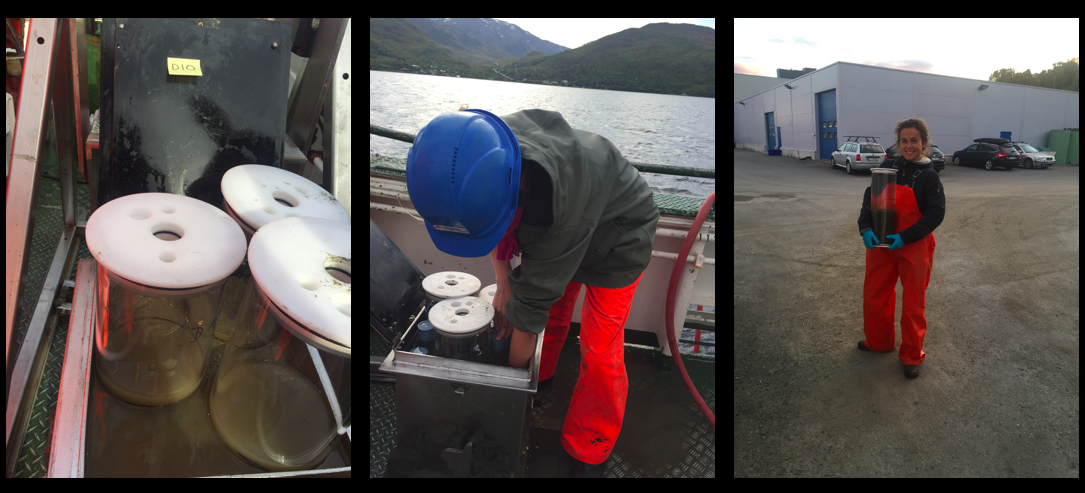
Experiment chambers were carefully pushed into the sediment in box core and sent over to the lab for further incubation experiments.

Silvia and Anouk slicing sediment cores for further chemical, foraminifera, 13C and nematode analysis.


Despite some difficulties with coarse and rocky seabed several Gemini cores were also collected in Kaldfjorden.
Kaldfjorden Sediment Trap Deployment
Sediment traps were deployed in the Arctic fjord Kaldfjorden, Kvaløya, Tromsø on the 8th September 2017 by Andrew Sweetman (Heriot Watt University), Marta Cecchetto (Heriot Watt University), Hege Vågen (University of Oslo) and Carl Ballantine (Akvaplan Niva).
Traps will remain in the fjord for 10 months were they will measure the flux of organic material to the seafloor close to a fish farm and in a control site in the center of the fjord.
 |
| Andrew, Carl and Marta heading out to deploy the first sediment trap |
 |
| Preparing the trap mooring |
 |
| Preparing the acoustic releases for the sediment trap mooring deployment |
Monday, 18 September 2017


Thursday, 8 June 2017
Looking back at the lab experiment performed at IRIS (Stavanger) in September 2016, looking forward to work with this team on the next experiment in September 2017
WP2: Quantifying interactions between aquaculture and jelly-falls on organic
matter cycling
in fjord sediments.
Sediments collected in Hardanger fjord at two different depths, in the vicinity and at a distance from a fish farm were collected and incubated in the lab at IRIS.


 Andrew Sweetman measuring oxygen profiles in the sediment of experimental cores.


Sediments collected in Hardanger fjord at two different depths, in the vicinity and at a distance from a fish farm were collected and incubated in the lab at IRIS.

Periphylla periphylla being thawed, weighed and cut before addition to the sediment cores.
Sediment cores incubated in the lab. Andrew Sweetman adding 13C labelled algae before the addition of P. periphylla.


Slicing, measuring, mixing, subsampling and sieving sediments at the end of the experiment.

Team work at its best!
Monday, 29 May 2017
JellyFarm Meeting, Oslo, 22nd to 24th May
 |
| The JellyFarm Project team in Oslo for the 2017 JellyFarm Meeting. |
 | ||
The JellyFarm Project team in Oslo for the 2017 JellyFarm Meeting.
|

 |
| Lars Birkeland Sjetne (University of Olso) presented results from his masters thesis examining organic carbon accumulation from fish farms in Hardangerfjorden, using a micro paleontological and geochemical study. |
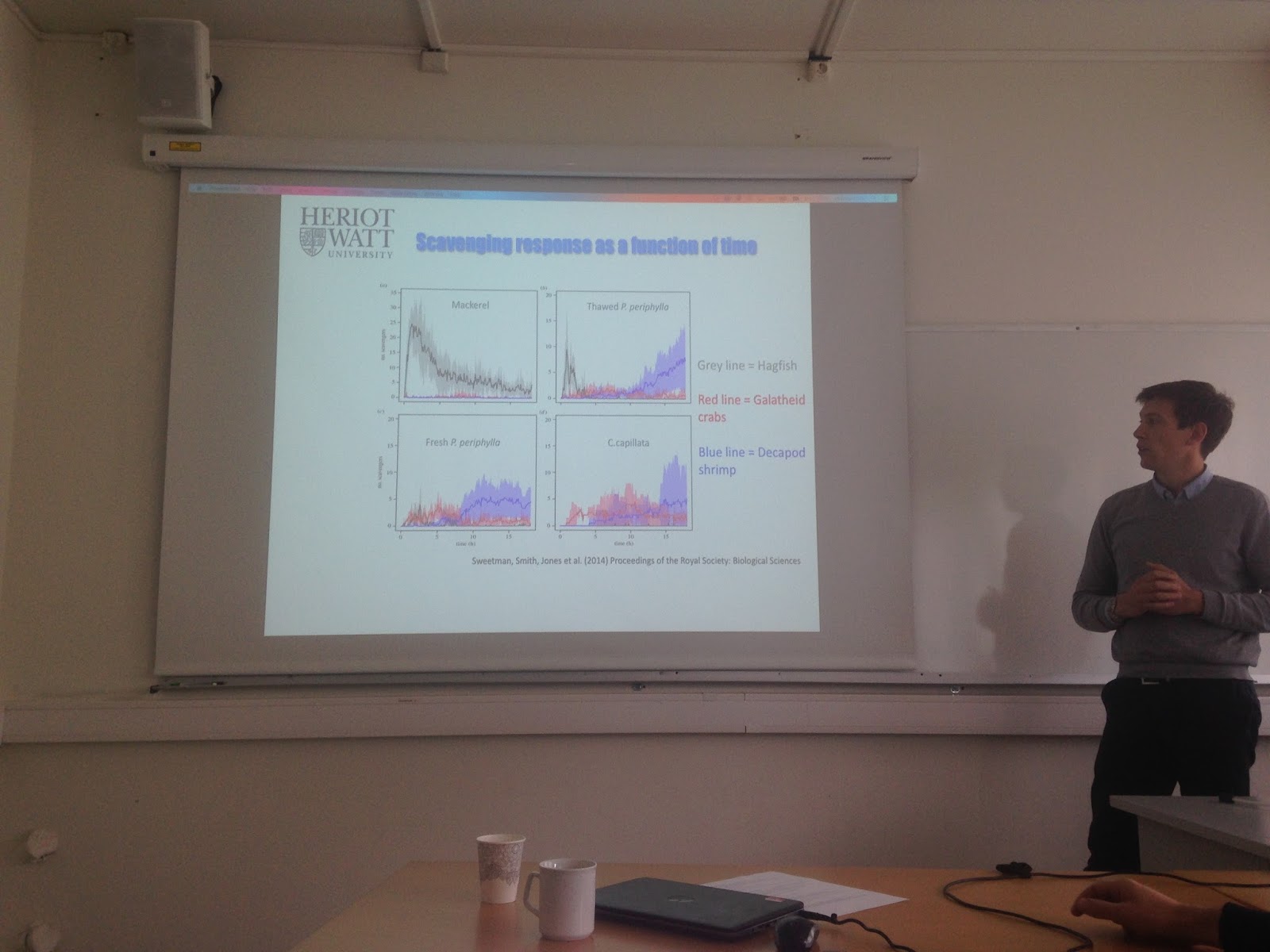 |
| Dr Dan Jones (National Oceanography Centre, Southampton) presented results from work package 5 examining depth effects on jellyfall scavenging dynamics. |
 |
| Dr Paul Renaud (Akvaplan Niva) coordinates planning for experiments in the Fall to examine the combined effect of organic input from aquaculture and jellyfalls on benthic biogeochemistry in Kaldfjorden, North Norway. |
Subscribe to:
Posts (Atom)